[Most Recent Entries] [Calendar View] [Friends]
Below are 20 journal entries, after skipping by the 60 most recent ones recorded in
Hack a Day's LiveJournal:
| Sunday, December 29th, 2013 | |
| 12:01 am | Vibe Mirror
We love a good art-related project here at Hackaday, and [Wolfgang's] vibrating mirror prototype is worth a look: into its distorting, reflective surface, of course. [Wolfgang] began by laser cutting nine 1″ circles from an 8″ square mirror, then super glued a 1/4″ neoprene sheet to the back of the square, covering the holes. Each circular cutout received some custom acrylic backings, glued in place with a short piece of piano wire sticking out of the center. The resulting assemblage pushes through the neoprene backing like a giant thumbtack, thus holding all nine circular mirrors in place without restricting movement. The back end of the piano wire connects to yet another piece of acrylic, which is glued to a tiny vibrating motor. He uses some shift registers and an Arduino Uno to control the motors, and although there’s no source code to glance it, we’re guessing [Wolfgang] simply designed the nine mirrors to buzz about in different patterns and create visually interesting compositions. Check out a quick video of the final effect after the break, and if you can help [Wolfgang] out with a name for his device, hit us up with your suggestions in the comments.
Filed under: Arduino Hacks, Microcontrollers   |
| Saturday, December 28th, 2013 | |
| 9:01 pm | Chameleon Emulates Contactless Smart Cards
Researchers at Ruhr University of Bochum in Germany have been busy working with RFID and related devices for quite some time now. They call the fruit of their labors Chameleon, a versatile Contactless Smart Card Emulator. Contactless Smart Cards are RFID style devices that also contain a smart card style memory. These cards are often used for payment, replacing mag strip style credit cards. Philips MIFARE Classic cards are a common example of contactless smart cards. The Chameleon is set up to emulate any number of cards using the common 13.56MHz frequency band. Adding a new card is as simple as loading up a new CODEC and application to the firmware. Currently Chameleon can emulate MIFARE cards using the ISO14443A. The Chameleon is completely open source, and can be built for around $25 USD. The heart of the system is an Atmel ATxmega192A3 microcontroller. The 192 is a great microcontroller for this task because it contains hardware accelerators for both DES and AES-128. An FTDI USB interface chip is used to provide an optional communication link between a host computer and the ATxmega. The link can be used for debugging, as well as manipulating data in real-time. A host PC is not necessary for use though – the Chameleon will operate just fine as a stand alone unit. We definitely like this project – though we’re going to be doubling down on the shielding in our RF blocking wallets. Filed under: security hacks, wireless hacks   |
| 6:01 pm | Making An ARM Powered MIDI Synthesizer
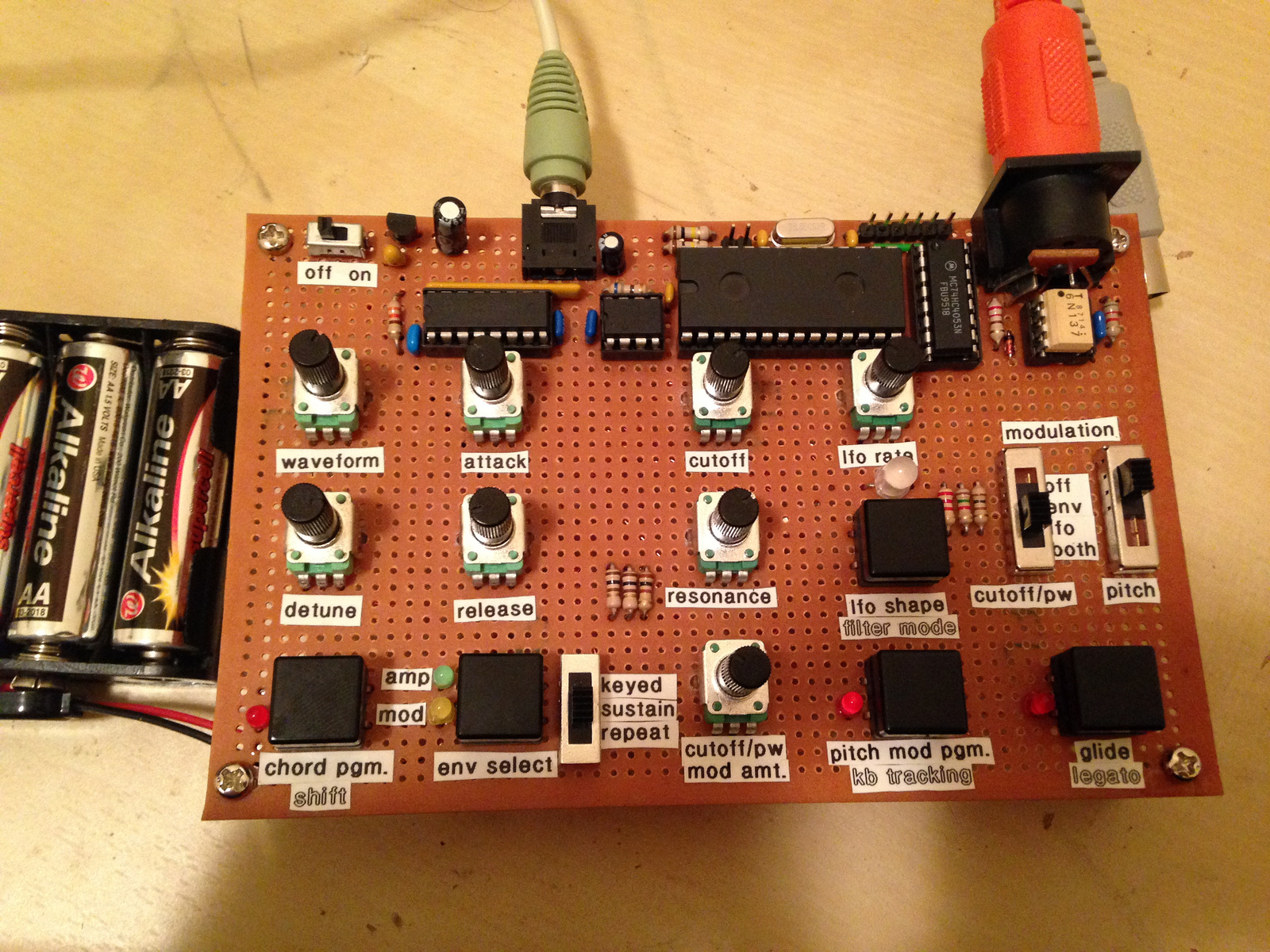
What you see in the picture above is a hand-made 4-oscillator synthesizer with MIDI input, multi-mode filter and a handful of modulation options. It was built by [Matt], an AVR accustomed electronics enthusiast who made an exception to his habits for this project. The core of the platform is a DIP packaged 32-bit Cortex-M0 ARM processor (LPC1114), stuffed with ‘hand’ written assembly code and compiled C functions. With a 50MHz clock speed, the microcontroller can output samples at 250kHz on the 12bit DAC while being powered by 3 AA batteries. Reading [Matt]‘s write-up, we discover that the firmware he created uses 4 oscillators (sawtooth or pulse shape) together with a low frequency oscillator (triangle, ramp, square, random shapes). It also includes a 2-pole state-variable filter and the ability to adjust the attack-release envelopes (among others). The system takes MIDI commands from a connected device. We embedded videos of his creation in action after the break.
Filed under: ARM, musical hacks   |
| 3:01 pm | Fubarino Contest: Custom Mech Warrior Online Controller
Twenty-two keys, a push button, three flip-switches, and a touch screen all let [Dominic] take his Mech Warrior Online game to the next level. He found that there are so many key bindings in the game it ends up being a huge pain to try to adapt his behavior to a static keyboard layout. Not only does the controller give him a specialized keypad, but he designed the touch screen interface to act as on-the-fly remapping. It even looks like something that would be mounted in a Battle Mech cockpit! What we can’t understand is why he didn’t tell us about this sexy peripheral hack much sooner? What finally prompted him to tip us off about his project was the Fubarino Contest. Above you can see the easter egg he added to the controller. When the bottom five buttons on the touch screen are mapped to “31337″ (aka “elite) the Teensy 3.0 board that drives the controller will automatically load up Hackaday in his browser. This is an entry in the Fubarino Contest for a chance at one of the 20 Fubarino SD boards which Microchip has put up as prizes! Filed under: contests, peripherals hacks   |
| 12:01 pm | The Magnetophone
The Magnetophone is the latest electro-acoustic instrument from [Aaron Sherwood]. This tower contains 14 strings, and 14 hand-wound electromagnets. By energizing each electromagnet with a square wave, the strings can be vibrated to create music. The brains of the device consist of an Arduino Mega attached to the top of the tower. The microcontroller has 6 timers, which allows for 6 notes to play at the same time. An open source tone library was used to generate square waves at the correct frequencies. These square waves are amplified by LM386 based circuits, which provide enough power to the coil to oscillate the string. By using square waves at specific frequencies, overtones of strings can be created. This isn’t the first time we’ve seen [Aaron] combine strings and electronics. His Glockentar used solenoids to strike strings. However, this project provides new possibilities by allowing the rate of oscillation to be controlled precisely. You can see the instrument in action after the break.
Filed under: musical hacks   |
| 9:01 am | Fubarino Contest: Serial Data Transmission
[Jesus] is helping his cousin learn about microcontrollers. Right now they’re on the subject of serial communications, which turned into a nice way to add a Hackaday Easter Egg. Using and FTDI chip in conjunction with the PIC 18F4550 (it’s a little soon for them to tackle implementing USB directly) the serial data is shown in a terminal window. At the same time the binary value of each byte is flashed on the PORTD LEDs. When the chip receives the characters “hack” it immediately echos back the recommendation to check out the awesomeness that is Hackaday. He posted the code used in this example as a Gist. This is an entry in the Fubarino Contest for a chance at one of the 20 Fubarino SD boards which Microchip has put up as prizes!
Filed under: contests   |
| 6:01 am | Raspberry Pi Car Deck
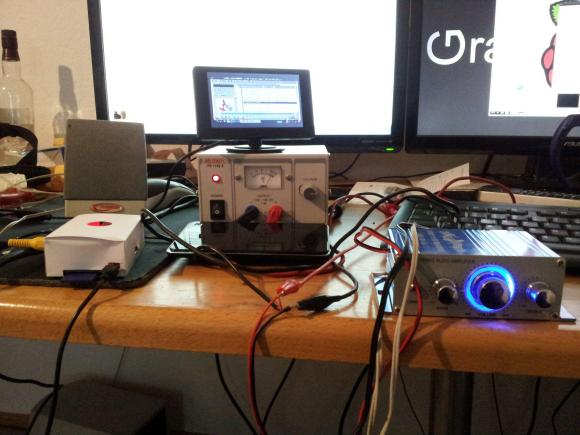
You can get all sorts of cheap car stereo decks from China, but where’s the fun in that? [Sentcool] is an IT specialist and electrician, and he decided he wanted something a bit more unique for his car — so he built this awesome Raspberry Pi car setup! He’s using a Raspberry Pi Model B R2, a standard LCD car display (from China), a small 12V audio amplifier and an NF filter. The image above is from the first test of all the components together. He originally wanted to use a touch screen, but thought it might be too expensive for the project, so instead he’s carefully soldered switches onto some ribbon cable for the Pi’s GPIOs. Don’t you just love stripping ribbon cable? From there it was just a matter of creating a nice wooden face plate and jamming everything into the center console of his car. It looks pretty good although the buttons could use some work — Don’t worry though, [Sentcool] is already thinking about upgrading it. See more after the break!
Filed under: Raspberry Pi   |
| 3:01 am | Fubarino Contest: Bluetooth Control for PC PSU
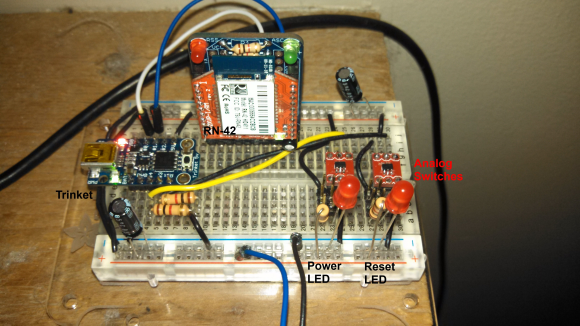
[Mike] wanted to have remote control of the power on his computer. But Wake-on-LAN wasn’t really all that interesting to him. Instead he set out to build this Bluetooth controller which manipulates the motherboard directly (PDF). Having been a winner of the Trinket Contest he based the project on that board which is seen on the left. There is also an RN-42 Bluetooth module and a couple of TI TS5A3157 analog switches. Once the prototype is finished the entire thing will run off of standby power and be located inside the case of his computer. The breadboard version just switches a couple of LEDs, but that will end up connecting to the pins for the power buttons once installed. The video after the break shows off the easter egg. The device is controlled by [Mike's] custom Android app. Every 42nd time he sends a power command the device calls back with our URL. This is an entry in the Fubarino Contest for a chance at one of the 20 Fubarino SD boards which Microchip has put up as prizes!
Filed under: computer hacks, contests   |
| 12:01 am | Hacking a Christmas Tree for Less Blinkyness
What good is a fiber optic self-lighting Christmas tree if it flashes so fast it will put you into an epileptic attack? The answer is “Not very good”, if you ask [Mads Nielsen] a.k.a [EcProjects]. So [EcProjects ] started a little project to slow the Christmas tree’s blinkyness down to a more reasonable rate. The task didn’t seem too difficult at first but turned into a quality tutorial building a variable frequency H-bridge motor control. After opening the base of the tree [EcProjects] found a 12 volt AC geared synchronous motor turning a multi colored translucent plastic disk. A bright spotlight was shining upwards through the turning disk into the ends of hundreds of small fiber optics. This mechanism dumps loads of multi colored light out the ends of the fibers at the tips of the Christmas tree branches as the disk turns. His goal was to slow down the motor; however, the rotation was based on the 50 Hz mains signal. In order to continue using this motor a lower frequency AC power source was needed. What follows in the video is an excellent lesson on how an AC synchronous motor works plus how to build a variable frequency control and H-bridge using some transistors, resistors and CMOS 4069 inverter chip. In the end the frequency drive could only be lowered to about 30 Hz before the synchronous motor would stall and reverse using his design. [EcProjects] was bold enough to include several fails which always provides more opportunity for learning and is greatly appreciated. If you believe you have a better solution please share your idea in the comments. I’m sure the first proposal will include an Arduino and servo modified for continuous rotation, but any solutions would be fascinating including modifications to his design. You can join us after the break to watch the video.
Filed under: Holiday Hacks   |
| Friday, December 27th, 2013 | |
| 9:01 pm | Fubarino Contest: Oscilloscope Clock
Before hearing about the Fubarino Contest [Joseph] never considered adding an Easter Egg to one of his own projects. But after seeing so many contest entries we think this is just the kind of fun extra that needs to make its way into every design! The subject of his entry is an oscilloscope clock which displays our URL instead of the numbers usually found on a clock face. He’s using a SparkFun board to generate the clock — a piece of hardware we saw about 18 months ago hidden inside of a vintage scope. The feature is unlocked only when displaying roman numerals in combination with a special serial command. Replacing the numerals with the URL isn’t entirely straight-forward. Since an oscilloscope is a vector display [Joseph] actually had to build his own array of start and end coordinates for each character. Luckily he did a fantastic job of documenting this which will allow you to make it say anything you wish. This is an entry in the Fubarino Contest for a chance at one of the 20 Fubarino SD boards which Microchip has put up as prizes! Filed under: contests   |
| 6:01 pm | Elinchrom EL-Skyport Triggered by Arduino
[Toby] has an Elinchrom EL-Skyport, which is a wireless flash trigger. He decided to see if he could trigger it using an Arduino, and came up with a nice proof of concept. This little device was not meant to be user serviceable, as can be seen in what [Toby] uncovered while taking it apart. But once he had it disassembled, he cataloged everything inside, and then he awesomely went to the trouble of drawing up a schematic. With that knowledge, he began reverse engineering the SPI protocol used, which almost deserves an article by itself. It was a long road to get there, but in the end [Toby] built a prototype Arduino shield that houses an nRF24L01+ module. These are very cheap to pick up on eBay. He gives us the details on hooking up the module, though he had to go through extra hoops since he was using the Arduino Leonardo. Still, once you’re up and running, you can make use of one of the existing libraries specifically for this module. Thanks to his effort, the rest of us have one more device to hack on. Thanks [Toby]!
Filed under: Arduino Hacks   |
| 3:00 pm | Fubarino Contest: Home Automation and Candle Flicker
Here’s a set of holiday themed contest entries: With a home automation system already in place, and considering the time of year, [Thom] chose to use his Christmas tree lights as the contest easter egg. When he uses his smart phone to set the fifth channel of the lighting controller to a 50% duty cycle it causes the string of lights to mete out the Hackaday web address as a series of dots and dashes. You can find the code here (DOC). [Jacques] offers up a flickering LED as the host of his hidden easter egg. When you short the two leads of the LED for a little bit it forces the PIC 10F200 into a different mode that then flashes our URL in Morse Code. Have a look at the assembly file. His implementation was based on the reverse engineering we saw recently. This is an entry in the Fubarino Contest for a chance at one of the 20 Fubarino SD boards which Microchip has put up as prizes!
Filed under: contests, Holiday Hacks   |
| 12:01 pm | Cleaning Slides with Plasma
[Ben Krasnow] hacked together a method of cleaning sides using plasma. His setup uses a mechanical vacuum pump to evacuate a bell jar. This bell jar is wrapped with a copper coil, which is connected to an RF transmitter. By transmitting RF into the coil, plasma is created inside the bell jar. Plasma cleaning is used extensively in the semiconductor industry. Depending on the gas used, it can have different cleaning effects. For example, an oxygen rich environment is very effective at breaking down organic bonds and removing hydrocarbons. It is used after manual cleaning to ensure that all impurities in the solvents used for cleaning are fully removed. According to [Ben], it’s possible to get a surface atomically clean using this process, and even remove the substrate if the energy levels are too high. These machines are usually expensive and specialized, but [Ben] managed to cook one up on his bench. After the break, check out a video walk through of [Ben]‘s plasma cleaner
Filed under: chemistry hacks   |
| 9:01 am | Motorized Longboard
What were you building in your junior year of highschool? Well, for [Aaron Cofield], he built a motorized longboard. He started with a plain longboard in the design he liked, gave it a nice paint coat (aesthetics over functionality people!) and then started looking into motorizing it. As it turns out there’s actually a pretty handy blog dedicated to converting longboards to electric. After many hours of research he settled on a 2400W RC prop motor and a 150A high performance RC car ESC unit. Who knew it was that simple! A few metal brackets, some belts, sprockets, an idler and a whole ton of lithium-ion batteries later and the build is complete! He’s currently controlling it with an RC car remote, but had plans to control it using a Wii nunchuck and Arduino. The test runs this past summer got the board going about 20mph! It looks done for now, but we’re sure he’s going to be continuing to refine it next summer — stick around after the break to see one of its first test drives!
Filed under: transportation hacks   |
| 6:00 am | Mega Tree Game Display
Christmas may be over, but the holiday hacks keep rolling in, like this awesome interactive Mega Tree Game Display! [Lior] loves setting up light shows every year (just check out last year’s awesome White Christmas display with music!), but taking them down just… well… sucks! So this year he decided to make a fully controllable non-holiday specific light display that he can reuse it all year long. It features 12 x 5 meter long waterproof RGB LED strips secured firmly to the front of his house, making a trapezoidal 12 x 150 pixel display. It was originally controlled with an Arduino but he found the USB connection was far too slow for the high frame rates he was aiming for — so he’s using a combination of a Raspberry Pi and a Teensy 2.0 instead. Now, just making a programmable light show suitable for all holidays is pretty cool we must admit, but as [Lior] puts it, a plain light show is “so last decade”. So he’s gone and made the whole thing smartphone interactive. Yep, you can actually log in with your phone and play a silly game that involves dropping gifts on houses and snowmen. He’s also got a pretty cool Hanukkah display that features a spinning dreidel! Check out the full demonstration video after the break.
Filed under: Holiday Hacks   |
| 3:00 am | Apple And Raspberry Pis
Deep in the bowels of the Internet there are some crazy people who have a wish list for what the next Apple II should look like. The capabilities of this dream machine of 80s retrocomputing is generally said to be something with a 32-bit CPU, a UNIX OS, modern graphics, and networking. This sounds a lot like a Raspberry Pi, so [Dave] built an Apple II to Raspberry Pi adapter card. Having a Pi talk to an Apple II over a serial connection doesn’t really give either machine the full capabilities of the other. To fix this issue, [Dave] wrote two pieces of software. The first is a UNIX daemon that listens to the Apple II on a serial port connection, handling the Apple II keyboard connection. The second piece of software is a ProDOS disk image file running on the Apple II. With these two pieces of software, [Dave] can run the Apple on the Raspi, or run the Raspi on the Apple, sending files and data back and forth with no problem. Aside from providing a strange and awesome Apple II to UNIX interface, the Apple II Pi also has a lot of advantages that might not be readily apparent. An Apple II compact flash adapter can be used as an internal hard drive for these pieces of classic apple hardware, and the Uthernet Ethernet card for the AII brings networking. Both of these devices are absurdly expensive compared to the component cost of the Apple II Pi, and what they bring to the table can be easily copied by the Apple II Pi. The Apple II Pi is just a simple double-sided board with a few resistors, a cap, header, a 7404 inverter, and a communications chip that’s $5 for quantity one. If you already have a Raspi hanging around your workbench and want to soup up an Apple II with some crazy hardware capabilities, you really can’t do better than getting one of these Apple II Pi boards. Now if we could only find the board files… Video of the Apple II Pi below, showing off all the awesome capabilities of a Pi-powered Apple. Thanks [Itay] for sending this one in.
Filed under: classic hacks, Raspberry Pi   |
| 12:00 am | Re-purposing an Old Laptop Display
One nice detail is in the control panel buttons. The LCD controller comes with a separate board housing the controls, and while he made a mistake mounting it initially, he ended up with a nice set of oak buttons that match the frame perfectly. He then built a nice backing out of styrene that holds the screen in place as well as housing the electronics. Overall, it’s a nice looking project, and it is always nice to see electronics re-purposed rather than ending up in a landfill. We can’t help but think this would be a great frame for building a picture frame or a wall-mounted PC as well. Filed under: computer hacks   |
| Thursday, December 26th, 2013 | |
| 9:01 pm | Fubarino Contest: FPGA Pong
For [Eric]‘s entry for our Fubarino Contest, he went down to very low-level hardware and created Pong on an FPGA. [Eric] used a Basys 2 FPGA board to create this virtual, logic gate version of Pong. Output is via the VGA port, multiplayer and an AI player is implemented, and all the required mechanics for Pong – collision detection, button and switch input, and score keeping are also in this project. The Fubarino contest requires an easter egg, of course, so when the score for the left player reaches 13 and the score for the right player reaches 37 (get it? 1337?), the previously square ball turns into an extremely pixeley version of the Hackaday logo. The Hackaday URL is also displayed, thanks to [Eric]‘s FP(V)GA module for displaying text on his FPGA board. The improved Pong ball and URL only appears when the scores are 13-37, making this an extremely well-hidden easter egg. Video of [Eric] demoing his Pong below. This is an entry in the Fubarino Contest for a chance at one of the 20 Fubarino SD boards which Microchip has put up as prizes!
Filed under: contests, FPGA   |
| 6:00 pm | Jello Shot Printer
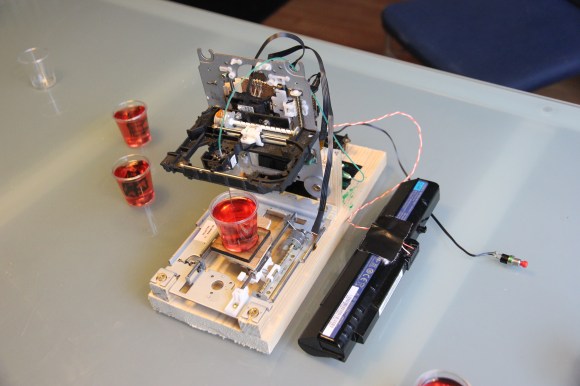
Classic. The great thing about the hacker-mindset is that you never say no when confronted with a problem! To achieve this printer, [Sprite_tm] has taken a handful of old CD-ROM drives to create a three axis moving platform. He’s using a forth drive’s ejector assembly to depress a syringe which pushes a concoction of banana liquor, green food colouring and cornstarch through medical tubing to the ink-head. To control it, he’s just using an ATTiny2313 with a mere 2K of memory. It took a bit of fiddling with to find the right flow, but works surprisingly well. Stick around after the break to see its printing capabilities.
[via Reddit] Filed under: 3d Printer hacks   |
| 12:01 pm | Fubarino Contest: Hackaday In Your Soldering Iron
Besides a coffee pot, the most important tool on the electronic tinkerer’s workbench is the soldering iron. Surprisingly, though, we haven’t seen many people build their own soldering stations. [Pjkim] did, and went so far as to include an easter egg for our Fubarino contest. A few years ago, [Pjkim] received a free Soldering Iron Driver from Dangerous Prototypes. This awesome kit provides everything you could want out of a soldering iron – USB and serial data logging, a 2×16 display, compatibility with a whole bunch of solder tips, and it’s completely reprogrammable. [Pjkim]‘s task for the Fubarino contest was to put an easter egg somewhere in the soldering iron. He did that by having the Hackaday URL display when the iron is ready for use. This isn’t the only firmware modification, either: the new firmware also debounces the button presses and adds auto repeat. If you’re looking for some code, [Pjkim] put everything up on the Hackaday forums. There’s also a video showing off the easter egg available below. This is an entry in the Fubarino Contest for a chance at one of the 20 Fubarino SD boards which Microchip has put up as prizes!
Filed under: contests, tool hacks   |