| Cosmic particle accelerator seen |
16. Apr 2005|20:17 |
|
Astronomers have discovered a loop-like structure some 20 light-years across close to the centre of the Milky Way. 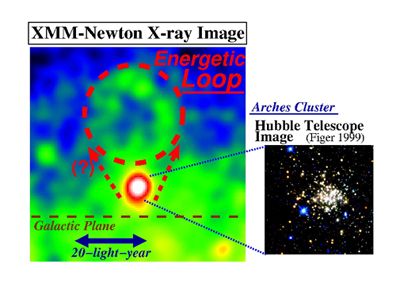
The team that found it believes the vast, bizarre structure could be some form of cosmic particle accelerator. The loop may produce sub-atomic particles with a thousand times more energy than those in man-made accelerators.
Details were presented at the National Astronomy Meeting in Birmingham.
The loop was seen using the European space telescope XMM-Newton to study it in X-ray wavelengths.
The galactic centre can only be observed at certain wavelengths - such as X-rays - because large amounts of dust lie in our line of sight, blocking out optical light.
"The X-ray spectrum of the loop is extraordinary," said Dr Masaaki Sakano of the University of Leicester.
Most diffuse X-ray sources in the Universe have a characteristic temperature because they represent the residual radiation from an event, such as a supernova.
"The loop has no characteristic temperature, so there is probably some ongoing process in there - that is our interpretation," Dr Sakano told the BBC News website.
"There are large amounts of high energy particles, so we interpret that they are being accelerated at the moment."
If this is so, the loop could be generating high-energy particles with an energy of up to one thousand trillion electron volts.
Particles such as these have been detected previously in supernova remnants and pulsar nebulae.
But they have never been detected in star-forming regions of the Universe.
The researchers saw the loop when looking at the Arches Cluster, a star-forming region close to the Milky Way's centre.
But it is not known whether the loop structure is physically associated with the Arches Cluster or just happens to be in the same line of sight. http://news.bbc.co.uk/1/hi/sci/tech/4423975.stm
http://ebulletin.le.ac.uk/news/press-releases/2000-2009/2005/04/nparticle-8xc-wk7-d8c |
|
